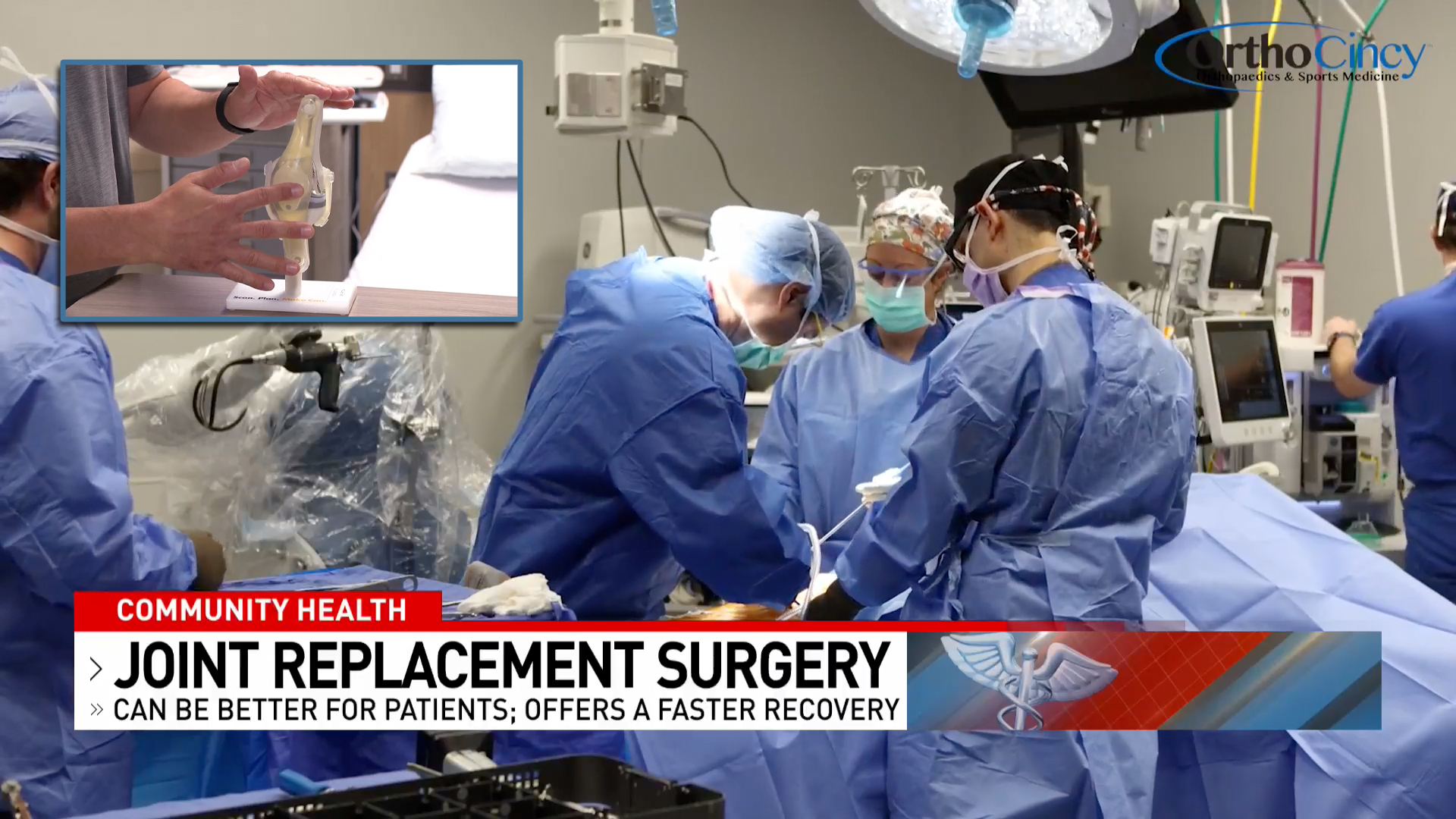


Total joint replacement surgery has become somewhat routine and more highly effective than ever, most commonly performed on the hip, knee, ankle, wrist, shoulder and elbow. Over the years, significant advancements in robotics, surgical techniques, approaches and materials have greatly improved patient outcomes.
Today, most people know someone who has undergone joint replacement surgery. OrthoCincy’s orthopaedic specialist are here to help determine whether this type of procedure is right for you. While total joint replacement may be necessary in some cases, less extensive options that provide partial relief may be suitable for others.
Despite the successes, several common myths surrounding total joint replacement surgery can cause hesitation or fear, so let’s set the record straight.
Myth 1: Joint pain is simply part of getting older.
Persistent joint pain is not an unavoidable consequence of aging. While that may have been true years ago, today many people in their 80s and 90s are staying active with sports like pickleball and golf. Joint pain is not something you have to accept as normal. Advances in joint replacement now allow arthritis to be treated so effectively that symptoms can often be eliminated.
Myth 2: I am too young—or too old—for joint replacement.
Age alone should never be the deciding factor for joint replacement. Instead of asking, “Am I too young for this?” the better question is, “Do I want to keep living with pain, or get back to doing what I enjoy?” Arthritis does not discriminate by age. If pain is limiting your ability to live your life, joint replacement may be an option—no matter how old or young you are.
Myth 3: Joint replacement is one-size-fits-all and might not work for me.
Joint replacement is not a standardized, cookie-cutter procedure. Each surgery is tailored to the individual patient’s anatomy. Implants are designed to match your natural bone structure within millimeters, creating a personalized solution. It is not one-size-fits-all—it is patient-specific.
Myth 4: Joint replacements only last 10 years, so you should wait as long as possible.
This myth stems from older generations of joint replacement materials. While earlier implants had limitations, there have been major advancements in materials—especially plastics—over the past 30+ years. Today, it is common for joint replacements to last 25 years or more.
Myth 5: Joint replacement carries a high risk of complications or failure.
Serious complications are uncommon, and ongoing improvements in surgical techniques have greatly reduced risk. Overall, joint replacement is considered a highly successful and reliable procedure.
Myth 6: A foreign body inserted into my body might get rejected.
Specially developed materials are compatible with our body and can stay in the body forever without causing any side effects.
Myth 7: You will not be able to walk for weeks after surgery.
A common misconception is that recovery takes months before you can function normally. In reality, advances in surgery and rehabilitation allow most patients to walk shortly after the procedure—often on the same day.
Myth 8: You will not be able to play sports after a joint replacement.
Modern joint replacements are designed to support active lifestyles, including sports participation. In the past, higher activity levels were thought to cause faster wear. With today’s improved implant technology, there is no strong evidence that active individuals wear out their joint replacements faster than less active ones.
Myth 9: You cannot have a joint replacement if you are overweight.
While weight is an important consideration, it does not automatically exclude someone from joint replacement. Patients are educated about personal risk factors and how improvements can optimize outcomes. Instead of focusing on a single BMI number, progress and overall health are monitored to support a successful surgery.
Myth 10: Joint replacement is the only solution for joint pain.
Joint replacement is just one of several treatment options for arthritis. Alternatives may include conservative treatments or partial joint replacements. The goal is not always total replacement—it is choosing the right approach based on the location, severity, and impact of your joint pain.